

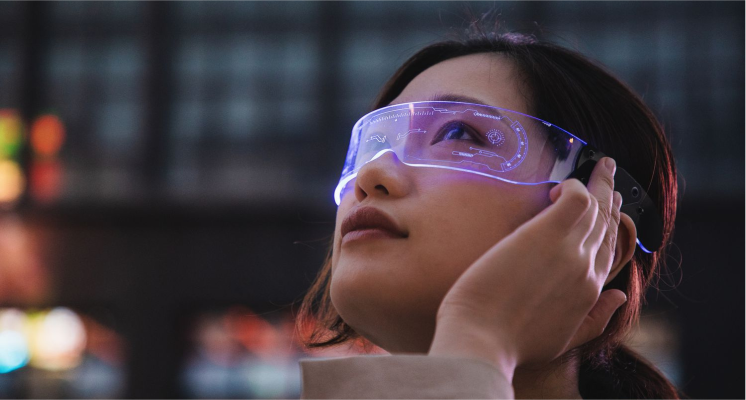
DAVOS, Switzerland -- Smart glasses will be the next central information device, Qualcomm's president and CEO told attendees at the annual meeting of the World Economic Forum here on Tuesday, calling them the next stage in an evolution that has progressed from personal computers to smartphones.
The next trend is the "merging of physical and digital spaces," Cristiano Amon said, noting that smartphones have the drawback of the limited size of the screen. Smart glasses are the device that his company is "very passionate about," he said.
Qualcomm, a U.S. company with a strong presence in mobile chips, is investing in areas such as virtual and augmented reality to prepare for this, the CEO said.
"It's going to happen," Amon said, also commenting about the metaverse, a virtual reality space in which users can interact and trade goods similar to the real world.
Amon and other top executives took the stage at the Davos forum on Tuesday, offering predictions on technology trends.
Sunil Bharti Mittal, chairman of Indian group Bharti Enterprises, said that with the spread of 5G communication technology, emerging countries such as India will receive the same services as elites in developed nations.
"We will see democratizing of the massive amount of available products and services that are currently available [only] to the elite or the wealthy," the chairman said. People in rural India will gain access to advanced medical services using remote technology supported by the 5G network, he said.
Mittal said innovations such as drone management, remote surgery and autonomous driving will accelerate using the 5G communication network, on which his conglomerate is betting heavily.
He emphasized that emerging nations such as India are in a position to take full advantage of these innovations, saying that "millions" of people will be able to attend events such as the Davos conference -- open only to the world's elites -- using metaverse technology.
Mittal also commented on the tech tensions between Washington and Beijing, saying India "definitely" benefits from the conflict "because the U.S. wants a lot of things to be shifted from China to India."
While noting that India is investing heavily in tech-related manufacturing capabilities, the chairman said that "trusted nations, trusted sources, trusted products" are "becoming the mantra."
Arvind Krishna, chairman and chief executive of IBM, revealed that his company's focus on quantum computing would provide the ability to solve problems in areas such as materials science later this year.
"You're beginning to see problems being solved that we just couldn't imagine getting solved on what are called classical computers," he said.
Mittal, responding to concerns that artificial intelligence will take away jobs, said many existing skills "will be replaced." But the chairman said these will be "compensated by many more areas of new discoveries of jobs and work."