

Foreign investors have stepped up their purchases of Chinese stocks in 2023 as a weekslong share-market rally in the world's second-largest economy forces fund managers to retreat from bearish positions.
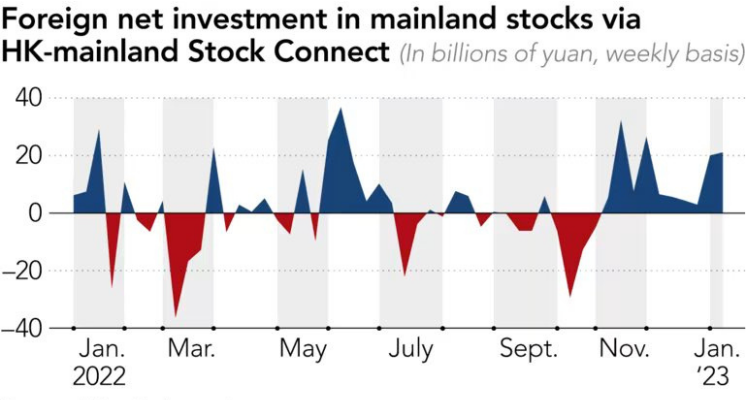
In the first nine trading days of the new year, foreign investors bought a net 64 billion yuan ($9.5 billion) of Chinese stocks via the trading link between the mainland and Hong Kong. That compares with only 90 billion yuan in net purchases for all of 2022, which was the lowest figure since 2017.
Analysts say many of the foreign buyers remain worried about China's prospects but are reversing course because of the rally that began in early November. Some are closing out bets -- called "short sales" -- that shares would fall. Others are adding to "underweight" positions -- meaning they have less exposure to China than the benchmarks they use to gauge performance.
"I wouldn't say that investor sentiment or their positioning is even back to neutral," said Jian Shi Cortesi, who manages $400 million in two funds for Zurich-based GAM Investment that have exposure to China.
She said there is still a "quite significant underweight in China" but that "as China starts to perform, if you are underweight, you are suffering." A Jan. 9 Goldman Sachs report said the Chinese allocations of global mutual funds with $800bn in assets were 410 basis points below their benchmarks.
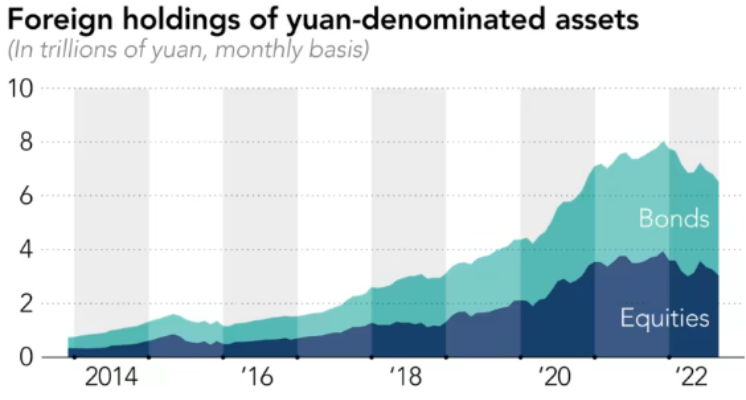
Pessimism about Chinese equities peaked around the time President Xi Jinping secured an unprecedented third term in office at the 20th Party Congress in October. In September, the holdings of foreign investors in China fell below 4% of total stock market capitalization, according to the latest data available from the People's Bank of China.
Since then, sentiment has been buoyed by a sudden shift in zero-COVID policies in December, surprising investors who did not expect China to open up for months. Investors have also been encouraged by indications Beijing is ending its crackdown on the domestic internet sector.
China's CSI 300 has climbed some 16% since hitting a 2022 low of 3541.33 at the end of October. It had declined by almost 40% last year until that point. Hong Kong's Hang Seng Index, which was down 58% for the year through October, has climbed around 48% since then.
There also have been signs of a thaw in the market for initial public offerings in Hong Kong, a popular listing spot for Chinese companies. Since late December, four of the six IPOs for mainland companies in Hong Kong -- which together are trying to raise 2 billion Hong Kong dollars ($260 million) -- have been oversubscribed, a rarity in 2022.
Robert Buckland, chief global equity strategist at Citi Investment Research, told a webinar last week that his clients in Singapore were less worried about China becoming an "uninvestable" market. "What's going on in China looks like it's not even a U-turn on COVID, it's a V-turn on COVID," he said.
Buckland said even though he is cautious about China's economy, "that doesn't mean we can't have a kind of decent six months for China assets as we step away from China being completely uninvestable to being a troubled asset class." He described himself as "overweight" China.
Nicholas Yeo, head of China equities at Abrdn, who is positive on Chinese markets, said there were still many "question marks" from investors on China equities -- including the impact of COVID. Citing a recent trip to Europe, he said investors who lost money because of Western sanctions imposed in response to the Russian invasion of Ukraine were also concerned about Beijing's relationship with Moscow.
Hugues Rialan, chief investment officer and head of discretionary portfolio management for Asia at Pictet Wealth Management, said his company is not jumping to increase its China exposure yet even though he expects China could deliver the best return of any major stock market in 2023.
Rialan pointed out that the first leg of the turnaround in the Chinese market has been led by investors reversing bearish bets. He said long-term investors are "progressively coming back."
Chris Leung, chief China economist at DBS bank, said China's path to recovery contains many unknowns, including the possibility that consumer consumption behavior has changed in ways that could hold back stock prices.
A research report last week by banking group ANZ said it was unlikely the reopening would encourage risk-averse consumers who suffered from the property sector downturn during China's restrictive COVID policies to spend more of their bank deposits -- which increased by seven trillion yuan in 2022.
Chinese tourists also have not flocked to Hong Kong, a popular shopping destination, after quarantine restrictions were dropped on the mainland. More people went from Hong Kong to the mainland than the other way around. There was a net outflow of more than 32,000 people from Hong Kong to the mainland after the border crossing reopened on Jan. 8, according to Hong Kong immigration data.
"It's a misconception to equate a fast stock rebound to a similar rebound speed [in the economy]," Leung said.